
DataFeedWatch vs AI Shopping Feeds: Complete 2026 Comparison Guide
In-depth comparison of DataFeedWatch and AI Shopping Feeds. Compare features, pricing, AI capabilities, and channel support to find the best feed management solution.
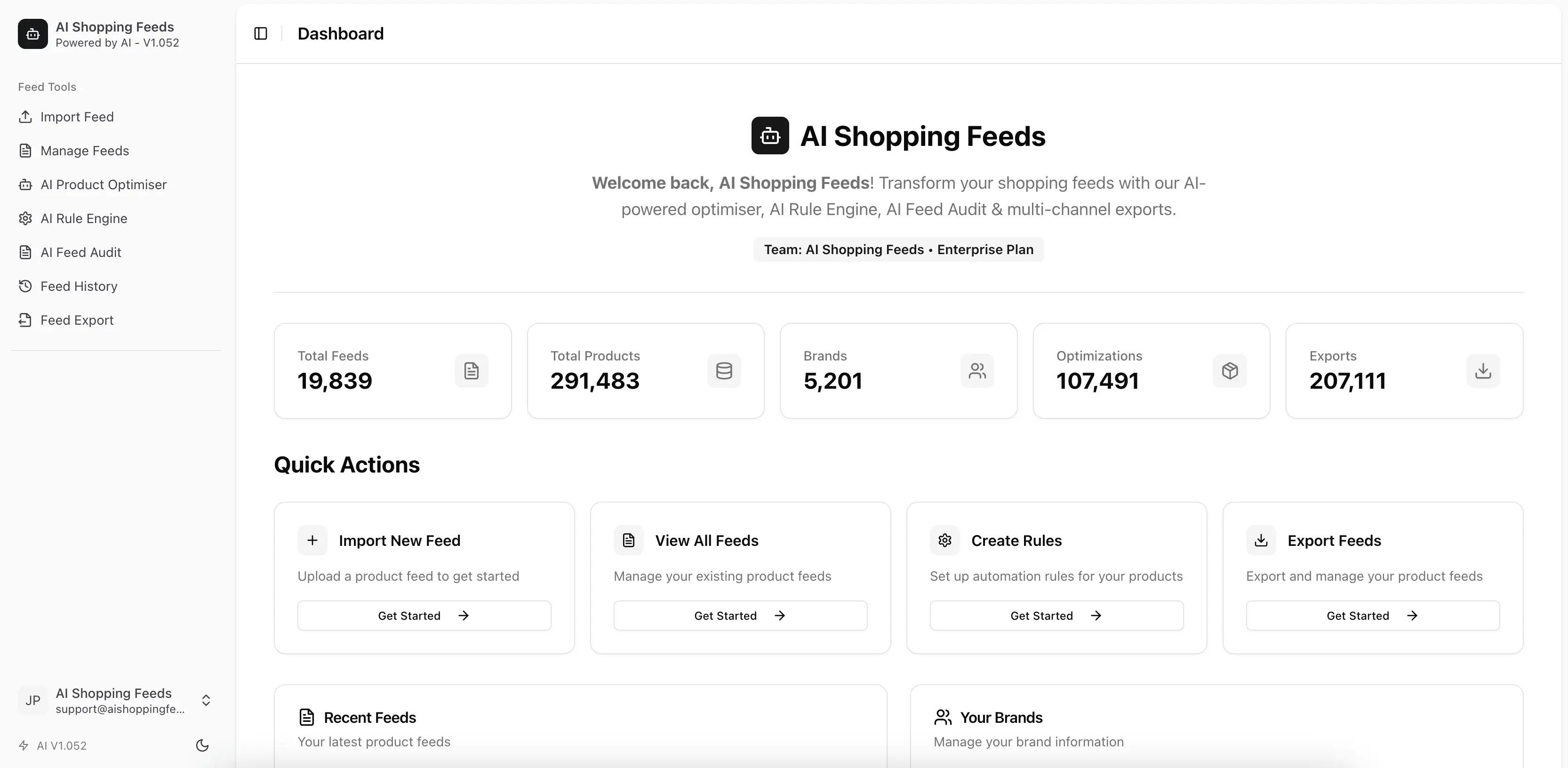
DataFeedWatch and AI Shopping Feeds represent two generations of feed management technology. DataFeedWatch pioneered self-service feed management with powerful rules-based optimization, while AI Shopping Feeds brings machine learning automation to the category. This comparison helps you understand which approach fits your needs.
Quick Comparison Overview
| Factor | DataFeedWatch | AI Shopping Feeds |
|---|---|---|
| Founded | 2009 | 2024 |
| Technology | Rules-based | AI/ML-powered |
| Starting Price | $64/month (Shop tier) | Free tier available |
| Free Trial | 15 days | Yes, no credit card |
| Channels | 2,000+ | 200+ |
| Optimization | Manual rules | Automated AI |
| Learning | Static rules | Continuous ML |
| Best For | Rule-based power users | Automation-focused users |
Platform Backgrounds
DataFeedWatch Overview
DataFeedWatch is a well-established feed management platform with over 15 years in the market. Acquired by Cart.com in 2021, it offers comprehensive feed management through a powerful rules-based interface.
Key Strengths:
- 15+ years of industry experience
- Massive channel library (2,000+)
- Powerful transformation rules
- Strong Google Shopping focus
- Established user community
Primary Users: Agencies, experienced feed managers, Google Shopping-focused businesses
AI Shopping Feeds Overview
AI Shopping Feeds represents the next generation of feed management, using machine learning to automate what traditionally required manual rule configuration.
Key Strengths:
- AI-native architecture
- Automated optimization without rules
- Continuous learning from performance
- Modern, intuitive interface
- Emerging AI commerce support
Primary Users: Businesses seeking automation, teams without dedicated feed specialists
Feature Comparison
Feed Optimization Approaches
DataFeedWatch Approach:
Manual Process:
1. Analyze product data manually
2. Write transformation rules
3. Test rules on sample products
4. Deploy rules to feed
5. Monitor results
6. Adjust rules manually based on performance
AI Shopping Feeds Approach:
Automated Process:
1. Import product data
2. AI analyzes patterns and performance
3. AI suggests/applies optimizations
4. Machine learning improves over time
5. Continuous automatic optimization
Title Optimization Comparison
| Capability | DataFeedWatch | AI Shopping Feeds |
|---|---|---|
| Method | Manual rules | AI-generated |
| Setup time | Hours/days | Minutes |
| Keyword research | Manual | AI-assisted |
| A/B testing | Not built-in | Automated |
| Performance learning | Manual review | Automatic |
| Bulk optimization | Rule-by-rule | One-click |
DataFeedWatch Example:
Create Rule:
IF category CONTAINS "Shoes" THEN
  PREPEND brand TO title
  APPEND size AND color TO title
  LIMIT to 150 characters
AI Shopping Feeds Example:
Import products → AI analyzes category → AI generates optimized titles
incorporating brand, key features, and high-performing keywords
automatically, learning from click-through and conversion data.
Channel Support
DataFeedWatch (2,000+ channels):
- Extensive library built over 15 years
- Templates for nearly every channel
- Many regional and niche channels
- Google Shopping optimization focus
- Standard advertising platforms
AI Shopping Feeds (200+ channels):
- All major advertising platforms
- All major marketplaces
- Social commerce platforms
- Emerging AI commerce channels
- Focused on highest-traffic channels
Key Difference: DataFeedWatch has more total channel templates (quantity), while AI Shopping Feeds focuses on highest-impact channels plus emerging AI commerce platforms.
Data Transformation
| Feature | DataFeedWatch | AI Shopping Feeds |
|---|---|---|
| Rule builder | Yes, powerful | Yes, plus AI |
| Regex support | Yes | Yes |
| Lookup tables | Yes | Yes |
| Conditional logic | Yes | Yes + AI suggestions |
| Bulk operations | Yes | Yes, one-click |
| Custom fields | Yes | Yes |
| Error prevention | Rules-based | AI-predictive |
Verdict: DataFeedWatch offers more granular rule control for power users. AI Shopping Feeds automates most transformations that would require rules in DataFeedWatch.
Error Handling
DataFeedWatch:
- Error detection and reporting
- Manual fix required
- Quality score tracking
- Channel-specific validation
AI Shopping Feeds:
- AI-powered error prediction
- Automatic error correction
- Proactive issue detection
- Self-healing capabilities
Pricing Comparison
DataFeedWatch Pricing
| Plan | Price | Products | Channels |
|---|---|---|---|
| Shop | $64/month | 1,000 | Unlimited |
| Merchant | $84/month | 5,000 | Unlimited |
| Agency | $239/month | 20,000 | Unlimited |
| Enterprise | Custom | 100,000+ | Unlimited |
Additional Costs:
- Comparison shopping add-on: +$19-59/month
- Extra products: Variable pricing
- Annual discount: ~17% savings
AI Shopping Feeds Pricing
| Plan | Price | Features |
|---|---|---|
| Free | $0/month | Basic optimization |
| Starter | $29/month | Core AI features |
| Growth | $79/month | Full optimization suite |
| Pro | $199/month | Advanced + priority support |
| Enterprise | Custom | Custom solutions |
Cost Comparison (5,000 Products)
| Platform | Monthly | Annual |
|---|---|---|
| DataFeedWatch Merchant | $84 | $1,008 |
| AI Shopping Feeds Growth | $79 | $948 |
| Difference | $5/month | $60/year |
For similar product counts, pricing is comparable. The key difference is what you get for the price:
- DataFeedWatch: Powerful rules engine, manual optimization
- AI Shopping Feeds: AI automation, less manual work
User Experience Comparison
Learning Curve
| Aspect | DataFeedWatch | AI Shopping Feeds |
|---|---|---|
| Initial setup | Moderate | Easy |
| Rule creation | Steep learning curve | Minimal (AI handles) |
| Channel mapping | Manual work required | AI-assisted |
| Ongoing management | Regular rule updates | Mostly automated |
| Training required | Significant | Minimal |
Interface Comparison
DataFeedWatch Interface:
- Feature-rich but complex
- Multiple screens for different functions
- Power-user oriented
- Comprehensive but overwhelming for beginners
AI Shopping Feeds Interface:
- Modern, clean design
- Single dashboard focus
- AI suggestions prominently displayed
- Beginner-friendly with advanced options
Use Case Analysis
Choose DataFeedWatch If:
- You’re an agency managing many client feeds
- You have dedicated feed management specialists
- You need extremely granular rule control
- You require templates for obscure channels
- You prefer established platforms with long track records
- You enjoy building and fine-tuning rules
Ideal User Profile: “I’m a feed specialist at an agency. I manage 50+ client feeds and know exactly what rules I need. I want complete control over every transformation.”
Choose AI Shopping Feeds If:
- You want AI to handle optimization automatically
- You don’t have dedicated feed specialists
- You prefer automation over manual configuration
- You want modern AI commerce support
- You value time savings over granular control
- You’re new to feed management
Ideal User Profile: “I’m an e-commerce manager wearing many hats. I don’t have time to learn complex rule syntax. I want AI to optimize my feeds while I focus on strategy.”
Performance Comparison
Optimization Quality
Based on user testing and industry feedback:
| Metric | DataFeedWatch | AI Shopping Feeds |
|---|---|---|
| Title optimization | Expert-level (if you know the rules) | Consistent, AI-optimized |
| Error reduction | Good (manual) | Excellent (automated) |
| Time to optimize | Hours/days | Minutes |
| Consistency | Depends on rules | Consistent across catalog |
| Learning | Static | Continuous improvement |
Speed and Efficiency
| Process | DataFeedWatch | AI Shopping Feeds |
|---|---|---|
| Initial setup | 2-8 hours | 15-30 minutes |
| Adding new products | Manual rule check | Automatic |
| New channel setup | 1-2 hours per channel | 10-15 minutes |
| Error resolution | Manual analysis | Auto-suggested fixes |
Pros and Cons Summary
DataFeedWatch
Pros:
- ✅ 15+ years of refinement
- ✅ Massive channel library (2,000+)
- ✅ Extremely powerful rule system
- ✅ Great for power users and agencies
- ✅ Established support community
- ✅ Comprehensive documentation
Cons:
- ❌ Steep learning curve
- ❌ Time-intensive rule management
- ❌ No AI-powered optimization
- ❌ Manual updates required
- ❌ Complex interface for beginners
- ❌ No emerging AI commerce support
AI Shopping Feeds
Pros:
- ✅ AI automation reduces manual work
- ✅ Easy to use, fast setup
- ✅ Continuous learning and improvement
- ✅ Modern, clean interface
- ✅ Free trial without credit card
- ✅ Emerging AI commerce support
- ✅ Consistent optimization quality
Cons:
- ❌ Fewer total channel templates
- ❌ Less granular rule control
- ❌ Newer platform (less history)
- ❌ May not suit agencies wanting manual control
- ❌ Some advanced transformations may need workarounds
Migration Guide
Switching from DataFeedWatch to AI Shopping Feeds
- Export your current feed from DataFeedWatch
- Document critical rules you want preserved
- Import products into AI Shopping Feeds
- Review AI suggestions — many rules may be unnecessary
- Add any custom rules for edge cases
- Test channels before fully switching
- Run parallel for 2-4 weeks
What you’ll gain: Automation, reduced manual work, AI learning What to watch: Complex custom rules may need recreation
Switching from AI Shopping Feeds to DataFeedWatch
- Export product data as CSV/XML
- Import into DataFeedWatch
- Set up channel templates
- Create transformation rules manually
- Test and iterate on rules
What you’ll gain: More channel templates, granular control What you’ll lose: AI automation, continuous learning
FAQ
Is DataFeedWatch better for agencies?
DataFeedWatch’s granular control makes it popular with agencies. However, agencies focused on efficiency may prefer AI Shopping Feeds’ automation, which reduces per-client management time.
Which is better for Google Shopping specifically?
Both are strong for Google Shopping. DataFeedWatch has years of Google Shopping-specific features. AI Shopping Feeds uses AI specifically trained on Google Shopping best practices.
Can I use both platforms together?
Yes, some businesses use DataFeedWatch for complex legacy feeds while using AI Shopping Feeds for new channels or simpler feeds.
Which is more future-proof?
AI Shopping Feeds is built for the AI commerce era with support for ChatGPT Shopping and emerging platforms. DataFeedWatch focuses on established channels.
Verdict
For Power Users & Agencies: DataFeedWatch’s mature rules engine and extensive channel library make it a strong choice if you have dedicated feed specialists who prefer manual control.
For Most E-commerce Businesses: AI Shopping Feeds offers the better value proposition, providing AI-powered automation that achieves comparable or better results with significantly less effort.
The fundamental question: Do you want to spend time writing and maintaining rules, or let AI handle optimization?
Related Resources
- Feedonomics vs AI Shopping Feeds
- Channable vs AI Shopping Feeds
- Best Product Feed Management Tools 2025
- AI Product Feed Optimization
Try AI Shopping Feeds
See the difference AI automation makes. Import your feed and let machine learning optimize your products automatically.
Start your free trial today — no credit card required, set up in minutes.
Why Wait? Try Free Today
Stop managing feeds manually. Start optimizing with AI.
Try AI Shopping Feeds Free →Join thousands of e-commerce businesses who've already made the switch to AI-powered feed management. Your products deserve to perform across every channel - let us make it happen.