Fix Google Merchant Center Errors with OpenClaw
Use OpenClaw with AI Shopping Feeds to inspect Merchant Center errors, prioritize the right fixes, and apply controlled remediation before publication.
 Maya Singhon March 6, 2026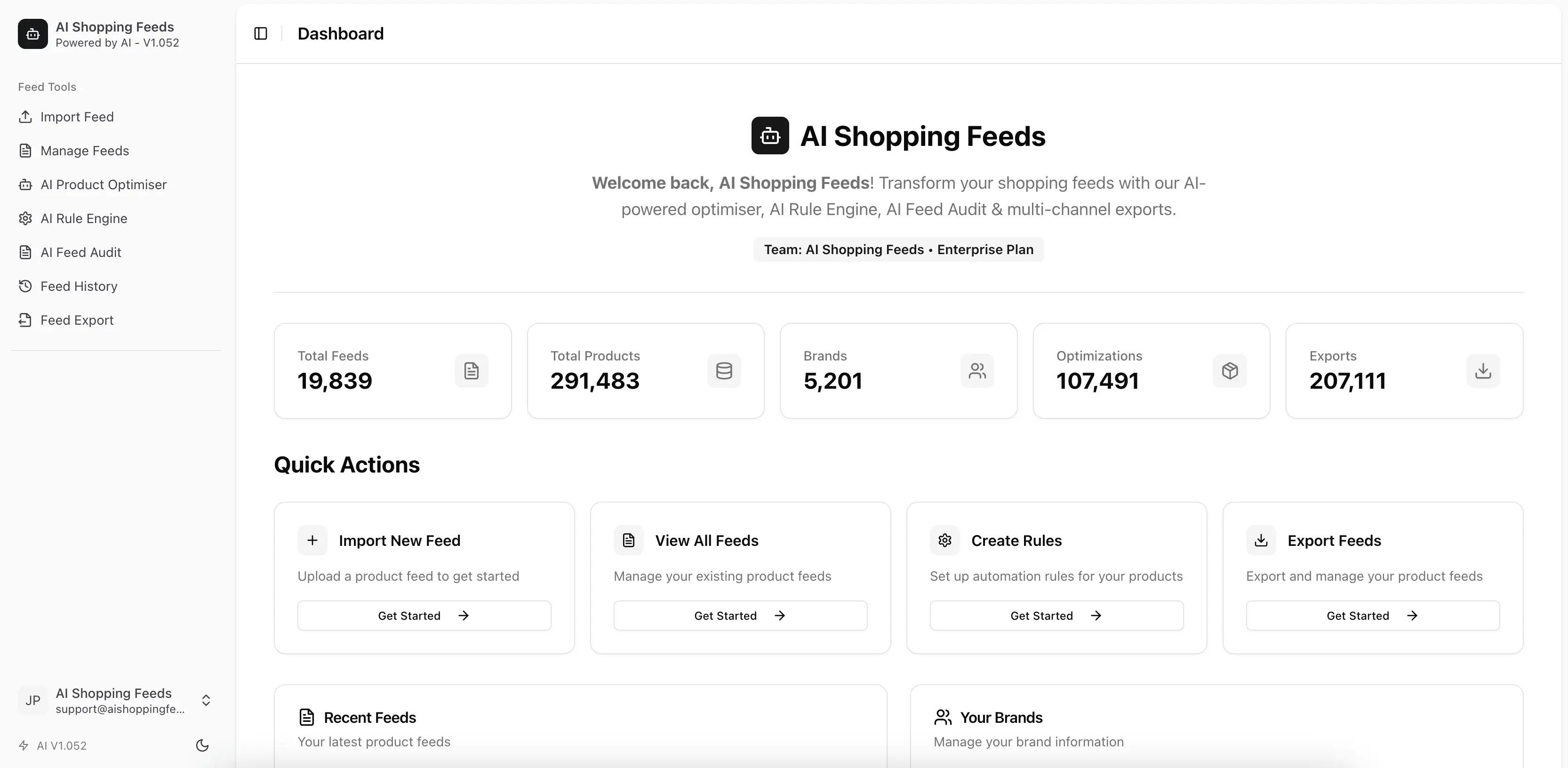
Searchers looking for “Google Merchant Center errors OpenClaw” are rarely looking for a magic button. They are looking for a workflow that lets an AI agent help with feed remediation without turning product-data changes into a blind automation risk.
That is the right way to frame the topic. OpenClaw can help teams inspect, categorize, and remediate feed issues through AI Shopping Feeds, but the value comes from stronger workflow discipline, not from pretending a model can bypass Merchant Center requirements.
What AI Shopping Feeds does today
The current product gives teams a feed-management operating layer with:
- brands, feeds, and products CRUD
- rules and AI optimisation
- MCP and OpenClaw support
- export and feed URL workflows
- team-scoped API keys and confirmation boundaries for risky agent actions
That means an agent can participate in the remediation workflow on top of a real feed-management system instead of acting as a detached advisor.
How it works in our app
The OpenClaw setup uses the published SKILL.md and an MCP-first connection to AI Shopping Feeds. Once connected, the agent can inspect feeds, review products, and help operators decide where the issue actually lives before any change is applied.
The safest pattern is inspect first
The first useful job is to identify:
- which feed is affected
- which products are affected
- which issue family is recurring
- whether the problem belongs in source data, feed logic, or a product-level fix
Only after that analysis should the team move into approved remediation.
What kinds of Merchant Center problems this workflow can help with
This article stays grounded in the feed layer. OpenClaw is most useful where the problem is connected to product-data quality or feed operations:
- missing or weak identifiers
- titles or descriptions that need improvement
- category or product-type inconsistencies
- recurring publication-readiness issues
- subsets of products that clearly need controlled remediation
If the issue is purely a Google-owned account or policy decision outside the feed layer, the assistant should still help triage it, but the final resolution may depend on Google’s own documentation and systems.
Why OpenClaw can be useful for remediation
Error remediation is a good fit for an agent workflow because it combines inspection, prioritization, and narrow action. Those are tasks where human operators still matter, but repetitive review work can be accelerated significantly.
The assistant can:
- summarize issue clusters
- identify the smallest useful fix path
- propose targeted product changes
- help the operator verify the result before export
That is materially better than jumping between diagnostics views, spreadsheets, and one-off product edits.
Do not confuse remediation with autopilot
This is the most important caution in the entire topic. Merchant Center errors are not a license to rewrite the whole catalogue. Good remediation is:
- scoped
- reviewable
- traceable
- tied to the root cause
The more specific the issue family, the safer the agent workflow becomes.
A practical remediation sequence
Step 1: identify the affected feed and products
Start with the subset that actually needs attention. Broad, vague remediation jobs create unnecessary churn.
Step 2: classify the issue family
Ask whether the problem is:
- a source-data issue
- a feed-layer mapping issue
- a presentation-field issue
- a downstream account or policy issue
Step 3: choose the smallest useful fix
If the root cause is structural, fix it upstream when possible. If it is a presentation problem, use the feed layer or product update path. If it is uncertain, hold the change until the root cause is clearer.
Step 4: verify after action
Use the assistant to confirm the resulting state before the next export or publish cycle.
Why this is stronger than reactive manual cleanup
Manual error fixing often fails for three reasons:
- the same issue is fixed several times in several places
- there is no consistent classification of the root cause
- no one tracks whether the issue family returns
An OpenClaw-driven remediation workflow is stronger because it gives the team a consistent sequence: inspect, classify, act narrowly, verify, and then feed the learning back into the system.
How official Google documentation still fits
OpenClaw is helping with the feed layer, not replacing Google’s own standards. Teams still need the product data specification and related Merchant Center guidance to understand what the downstream system expects.
That is why this page does not promise blanket automated resolution. It promises a better remediation workflow around the implemented AI Shopping Feeds surfaces.
Common remediation mistakes
Mistake 1: using AI before the root cause is understood
This often masks the real issue temporarily instead of fixing it.
Mistake 2: applying a whole-catalogue rewrite
Large, unspecific changes make it harder to verify what improved and what regressed.
Mistake 3: leaving recurring structural issues in the export layer
If the issue comes from the source system, the long-term fix belongs there.
Mistake 4: publishing immediately after the write
Verification should happen before the next handoff.
Why this guidance is trustworthy
This article is grounded in the implemented AI Shopping Feeds OpenClaw and MCP setup, the feed-management surfaces behind it, and official Google documentation where Merchant Center standards matter. It keeps the promise operational on purpose: OpenClaw can improve remediation workflow, but it does not exempt the team from Google rules or human review.
Operational checklist before remediation starts
Before the agent is asked to change anything, the team should confirm a few simple things:
- the correct feed and product subset are in scope
- the error family has been named clearly
- the likely root cause has been classified
- the fix belongs in the feed layer rather than only in Google-owned systems
This small amount of discipline prevents the most common remediation mistake: changing data before the team understands why the issue exists.
Escalation rules for persistent error families
If the same issue returns repeatedly, treat it as a workflow problem, not a bad row problem. The team should ask:
- is the source system recreating the issue?
- is the feed-layer mapping unstable?
- is the operator using the agent for the wrong class of remediation?
OpenClaw is most helpful when it exposes recurring patterns and helps operators fix them systematically.
Metrics that show remediation is getting stronger
Useful measurements include:
- time from issue discovery to approved remediation
- recurrence rate of the same error family
- number of products that needed a second manual fix after the first agent-led pass
- percentage of fixes retired back into the source workflow
If these metrics improve, the team is using the agent as part of a stronger remediation process rather than as a shortcut.
Why this topic needs narrow promises
The fastest way to lose trust on this topic is to imply that OpenClaw automatically resolves Merchant Center problems end to end. The more honest and useful promise is that it helps teams inspect, classify, and remediate feed-layer issues through a governed workflow. That promise is easier to believe and easier to operationalize.
Final take
OpenClaw is useful for fixing Google Merchant Center errors when the problem is really feed work: diagnosis, prioritization, and narrow remediation inside a governed workflow. AI Shopping Feeds makes that practical because the agent can work through a real tool surface for feeds, products, optimisation, and exports while the team keeps scopes, confirmation, and review boundaries intact.
For the agent setup path, read Google Shopping OpenClaw Guide for Feed Automation. For the protocol-level audit flow, continue to Google Shopping Feed Audit with MCP.
Why wait? Try it free today.
Stop managing feeds manually. Start optimising with AI in 30 seconds.
- Free plan, no credit card required
- 1 brand, 1 feed, 100,000 products per feed
- Full AI Product Optimisation, Rule Engine, and 200+ channel exports
- Pay only for AI credits when you need them