Google Ads Product Feed Optimization Workflow
Step-by-step Google Ads product feed optimization workflow that moves raw catalog data to export-ready states using rules, selective AI, and controlled review.
 Maya Singhon March 6, 2026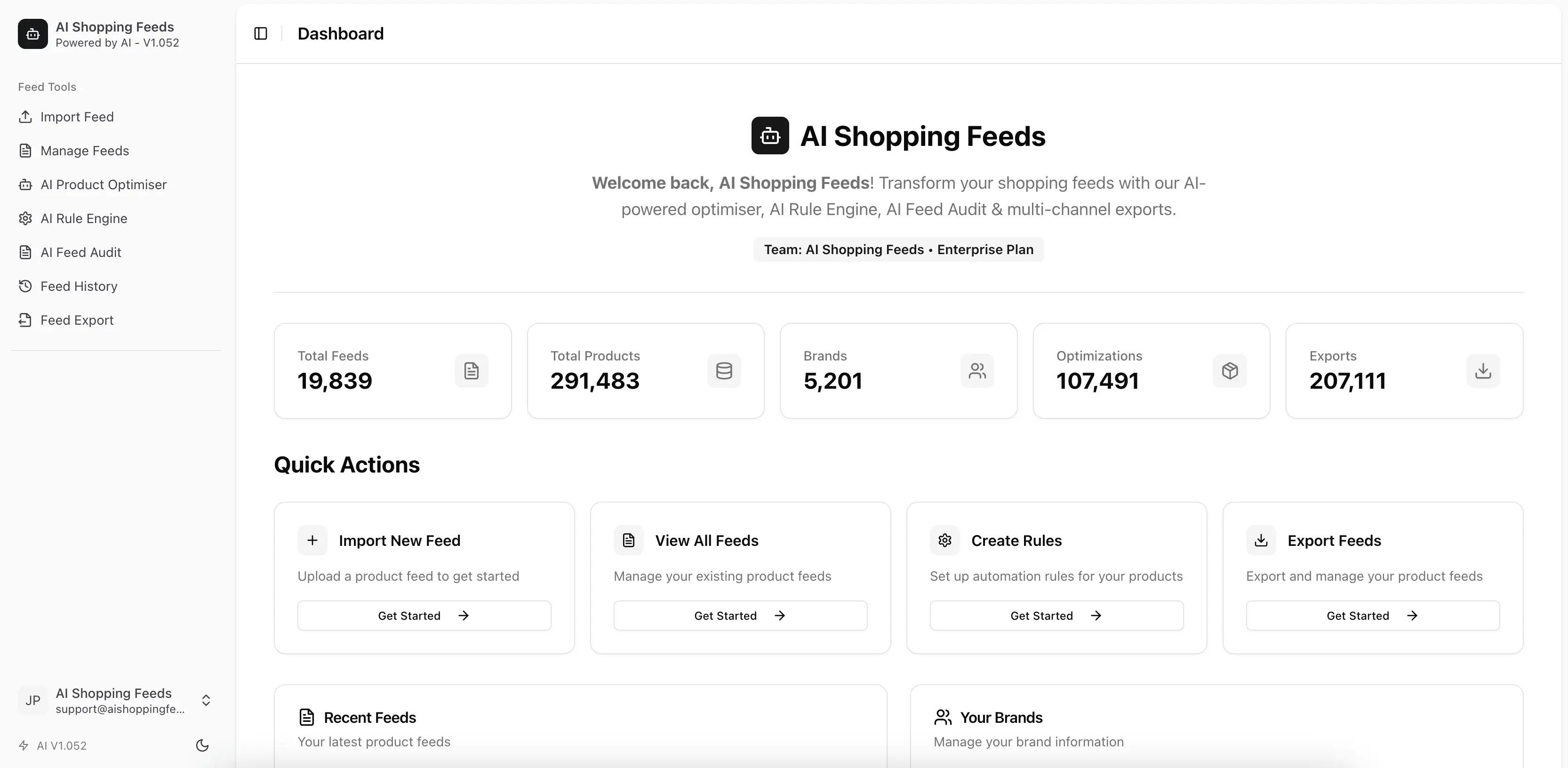
The phrase “Google Ads product feed optimization” often gets flattened into title rewriting, but strong feed optimization is much broader than copy improvement. The real workflow starts with product truth, moves through deterministic cleanup and selective AI usage, and ends only when the team has verified that the resulting feed state is genuinely ready for publication.
That is why this topic matters. Teams do not need another vague list of best practices. They need an operating workflow that explains what to fix first, what to automate, and where AI Shopping Feeds fits.
What AI Shopping Feeds does today
The current product gives teams a feed-management layer with:
- brands and feeds
- products CRUD and bulk operations
- rules for repeatable transformations
- AI optimisation surfaces
- export endpoints and public feed URLs
- broader connected workflows around Merchant Center and Google Ads operations
That means teams can move from raw catalogue state to reviewed, export-ready feed state inside one operating environment.
How it works in our app
The workflow in AI Shopping Feeds is not “press optimize.” It is:
- inspect the current feed
- improve deterministic issues first
- use AI on the subset where semantic improvement is useful
- verify the resulting state
- export or hand off the output
This sequence matters because it prevents AI from becoming a substitute for basic feed discipline.
Step 1: audit product truth first
Before any optimisation, check the fields that determine whether the feed is coherent:
- identifiers
- titles
- descriptions
- categories and product types
- price and availability
- image and landing-page alignment
If these are unstable, AI optimisation becomes noise. The first job is to understand what is structurally wrong and what is merely under-optimized.
Step 2: use rules for deterministic fixes
Rules are usually the correct tool when the transformation is predictable:
- prepend or append a consistent token
- normalize a field pattern
- copy values into a destination field
- strip known bad text
- enforce a segment-specific convention
These changes should not require AI. Deterministic work belongs in deterministic logic.
Step 3: use AI selectively
AI is valuable when semantic improvement matters:
- title improvement
- description improvement
- category refinement
- product-type refinement
The key word is selectively. Not every product needs AI every time. The strongest workflow targets the products and fields with meaningful room for improvement.
Step 4: verify after optimization
A successful AI call is not the end of the workflow. The team should confirm:
- the revised content still matches the product
- variant differentiation remains clear
- the output is commercially sensible
- the result is cleaner than the original
Without verification, optimization can create more review debt than it removes.
Step 5: export from the reviewed state
Once the improved state is accepted, the team can use the export workflow or the relevant handoff path. The important point is that the exported output should reflect a controlled, reviewed feed state rather than a collection of ad hoc edits.
Why this matters for Google Ads workflows
Even though the work happens in the feed layer, it still matters to Google Ads-oriented teams because the product data supporting Shopping workflows needs to be accurate, complete, and commercially useful. The better the workflow upstream, the less time the team spends chasing avoidable feed quality problems later.
That is the honest value proposition. Feed optimization supports readiness and quality. It should not be marketed as a direct guarantee of advertising outcomes.
A practical optimization model by issue type
Structural issues
Fix upstream or in mapping. Examples: missing identifiers, broken prices, missing required fields.
Deterministic presentation issues
Fix with rules. Examples: formatting consistency or repeatable field logic.
Semantic improvement opportunities
Fix with AI. Examples: weak titles, thin descriptions, better category phrasing.
Unclear issues
Hold for human review instead of guessing. Ambiguous products often create the most expensive mistakes.
Common workflow mistakes
Mistake 1: starting with AI
If the source data is broken, AI cannot save the workflow.
Mistake 2: applying AI to every product every cycle
This creates unnecessary cost and review work.
Mistake 3: optimizing without a publish boundary
The workflow needs a verification step before export.
Mistake 4: leaving recurring issues in the feed layer forever
If the same issue keeps returning, the root fix belongs upstream.
Where OpenClaw and MCP fit
The workflow can be driven in different ways:
- through the direct API for system-owned processes
- through MCP or OpenClaw for assistant-led reviews and targeted remediation
That makes AI Shopping Feeds flexible without changing the underlying feed-management model. The workflow stays the same. The interface changes.
How official Google documentation still fits
Google’s product data specification remains the external reference point for what the downstream product data should look like. Optimization should help teams meet or exceed those expectations, not invent a parallel standard.
That is why this article ties workflow claims back to product-data quality rather than ranking promises.
Why this guidance is trustworthy
This article is grounded in the current AI Shopping Feeds surfaces for feeds, products, rules, AI optimisation, and export workflows. It is written to explain the operating sequence clearly rather than oversell AI as a substitute for feed management discipline.
Operational checklist before optimization begins
The strongest optimisation teams start each cycle by confirming:
- which feed or product subset is in scope
- which fields are structurally broken versus merely weak
- which changes should be rules-driven
- which changes actually need AI review
This prevents optimisation from turning into generic rewrite churn.
Escalation rules for recurring weaknesses
If the same title, category, or attribute issues return every cycle, the team should ask whether the fix belongs upstream rather than in repeated feed-layer cleanup. Optimization is strongest when it improves the system over time, not when it recreates the same fixes forever.
Metrics that show the workflow is improving
Useful measures include:
- time from audit to reviewed export-ready state
- percentage of products improved through rules versus AI
- recurrence rate of the same content-quality issues
- number of optimization changes that required rollback after review
These metrics reveal whether the workflow is becoming more sustainable.
Why this topic needs a workflow lens
Google Ads feed optimisation is often sold as copy improvement, but the better story is process improvement. The more durable the workflow is, the easier it becomes to keep the feed clean as the catalogue changes. That is why this article keeps linking optimization back to governance, verification, and export readiness instead of promising performance magic.
Final take
A strong Google Ads product feed optimization workflow starts with product truth, uses rules for deterministic fixes, uses AI selectively for semantic improvement, verifies the output, and only then moves to export or publication. AI Shopping Feeds supports that full sequence in one place, which is why it is useful to mixed technical and merchant-ops teams.
For the audit-first protocol path, continue to Google Shopping Feed Audit with MCP. For the API architecture behind the workflow, read Ecommerce Feed API for Google Ads, Meta, and Marketplaces.
Why wait? Try it free today.
Stop managing feeds manually. Start optimising with AI in 30 seconds.
- Free plan, no credit card required
- 1 brand, 1 feed, 100,000 products per feed
- Full AI Product Optimisation, Rule Engine, and 200+ channel exports
- Pay only for AI credits when you need them