Google Shopping API vs MCP vs Feed Files
Compare Google Shopping API, MCP, and feed files to choose the right interface based on workflow ownership, automation needs, and review boundaries.
 Alex Turneron March 6, 2026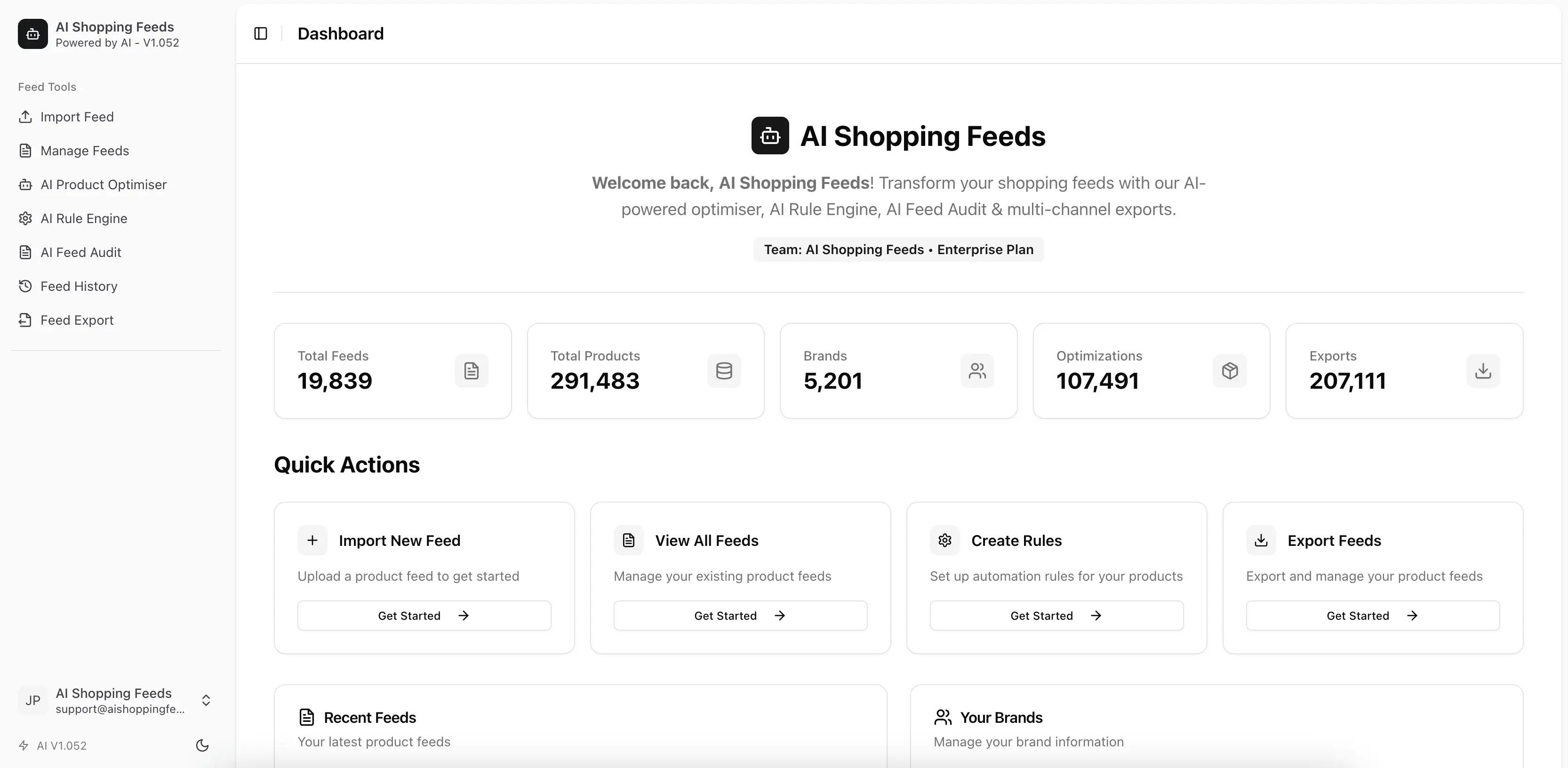
Teams evaluating Google Shopping workflows often force the wrong comparison. They compare “API” with “files” or “MCP” with “manual work” as if only one model can survive in the stack. In practice, the better question is simpler: which interface should own which part of the workflow?
That is what this article answers. AI Shopping Feeds supports direct API work, assistant-led MCP workflows, and file-oriented export patterns. The right model depends on workflow ownership, review boundaries, and how much automation should live in software versus operator-led sessions.
What AI Shopping Feeds does today
The current product supports:
- a public v1 REST API
- a public MCP endpoint
- export endpoints and public feed URL workflows
- brands, feeds, products, rules, and optimisation in the same underlying system
That means the comparison is not hypothetical. The interfaces already exist against the same managed feed layer.
How it works in our app
The feed state lives in AI Shopping Feeds. Teams manage products and feed logic there. From that same controlled state, the workflow can be accessed in different ways:
API
Your own application or service makes explicit requests to the public API and owns deterministic logic.
MCP
An assistant connects to the MCP tool surface and helps an operator inspect, propose, confirm, and verify changes.
Feed files
The team publishes or hands off a file-based output or public feed URL when that destination or process still expects it.
The critical point is that the feed state should stay singular even if the interfaces vary.
When direct APIs are the best fit
Use the API when:
- your application should own the workflow
- deterministic sequencing matters
- retries, monitoring, and error handling belong in code
- the process is system-driven rather than operator-led
This is the right fit for backend integrations and repeatable programmatic workflows.
When MCP is the best fit
Use MCP when:
- a human operator should drive the workflow through an assistant
- the job spans several feed tasks in one session
- tool discovery is useful
- review and confirmation boundaries matter
This is especially strong for audits, targeted remediation, and other judgment-heavy tasks.
When feed files are still the best fit
File-oriented publication is still useful when:
- the handoff destination expects a file or URL fetch
- the publication cadence is predictable
- the workflow does not justify a more complex integration yet
- the team can still govern the feed state effectively upstream
Files are not the enemy. Weak workflow ownership is the enemy.
Why the comparison is really about workflow ownership
This is the simplest way to choose correctly.
Software-owned workflow
Pick the API.
Operator-owned workflow
Pick MCP.
Stable downstream handoff
Keep feed files where they remain operationally sensible.
Many teams need all three, but in different parts of the stack.
The most practical hybrid model
For many organizations, the cleanest answer is:
- use API for software-owned jobs
- use MCP for review-heavy operator workflows
- use files or public feed URLs for destinations that still want them
That keeps the operating model simple while avoiding duplicate data stacks.
Why file-based workflows still matter
It is easy to overreact to protocol and API trends and assume files are outdated. In reality, file-based publication can still be perfectly valid when:
- the cadence is stable
- ownership is clear
- the feed layer upstream is well governed
What matters is not whether the final handoff is a file. What matters is whether the team has one trustworthy managed feed state behind that file.
Common mistakes when choosing
Mistake 1: assuming the newest interface is automatically the best
It is not. The best interface is the one that matches workflow ownership.
Mistake 2: forcing an assistant into system-owned jobs
MCP is powerful, but not every deterministic workflow should become conversational.
Mistake 3: keeping files as the only operating layer
Files can be fine for handoff, but not as the sole place where product-data governance happens.
Mistake 4: creating several parallel feed systems
Whichever interfaces you use, the feed state itself should remain singular and governed.
How official Google guidance fits
Google’s Merchant API overview and the product data specification still define the downstream expectations. The interface choice is about how your team manages the feed layer that prepares data to meet those expectations.
That is why this page does not claim that API, MCP, or files are ranking tactics. They are operating models.
Why this guidance is trustworthy
This article is grounded in the implemented AI Shopping Feeds surfaces for API, MCP, and export-oriented workflows, then framed around actual operating tradeoffs instead of generic format wars. That is the only useful way to compare these options for technical buyers and mixed operations teams.
Decision checklist before you change interfaces
Before moving from files to APIs or from APIs to MCP, teams should ask a few direct questions:
- who owns this workflow today?
- where does human review create value?
- which downstream destinations still require stable file or URL handoff?
- how much orchestration code is the team prepared to maintain?
- is the current pain caused by the interface, or by weak product-data governance?
This matters because many interface migrations are really attempts to solve governance problems with transport changes.
A rollout model that avoids unnecessary churn
The strongest migration path is usually incremental.
Keep files where they are still efficient
If a destination is already consuming a stable public feed URL and the process is well controlled, there is no virtue in replacing that path purely for fashion.
Add APIs where software ownership is valuable
When the workflow belongs in backend logic, move that part to the API.
Add MCP where operator-led review matters
When a human needs to inspect, propose, confirm, and verify, MCP often creates more value than writing another custom admin tool.
Metrics that show the interface mix is healthy
Teams should look for:
- reduced duplicate work across file, API, and operator workflows
- lower time to publish verified product-data changes
- fewer manual spreadsheet interventions
- clearer ownership when an issue appears downstream
- better reuse of the same feed logic across several destinations
These are better signals than whether the stack “looks modern.”
Why this comparison should stay practical
Google Shopping API vs MCP vs feed files sounds like a format war, but it is really a workflow-allocation problem. The most useful answer is often hybrid. What matters is that the team can explain why each interface exists and how each one interacts with the same underlying managed feed state.
If you start simple, how to expand later
A team can begin with file-based publication, then add API-driven operations where software ownership becomes necessary, then add MCP for operator-led audits or remediation. That path is usually less risky than trying to redesign the whole operating model in one move.
Final take
Google Shopping API vs MCP vs feed files is not a winner-takes-all contest. Use the API when software should own the workflow. Use MCP when an operator should work through an assistant. Keep files where a stable publication handoff still makes sense. The real priority is keeping one feed-management control plane underneath all three.
For the API architecture path, continue to Ecommerce Feed API for Google Ads, Meta, and Marketplaces. For the assistant path, read Google Shopping MCP Guide for Merchant Center Feed Operations.
Why wait? Try it free today.
Stop managing feeds manually. Start optimising with AI in 30 seconds.
- Free plan, no credit card required
- 1 brand, 1 feed, 100,000 products per feed
- Full AI Product Optimisation, Rule Engine, and 200+ channel exports
- Pay only for AI credits when you need them