Merchant Center Feed Automation for Large Catalogs
Practical guide to Merchant Center feed automation for large catalogs: organize feeds, automate repetitive work, and keep publication workflows controlled.
 Maya Singhon March 6, 2026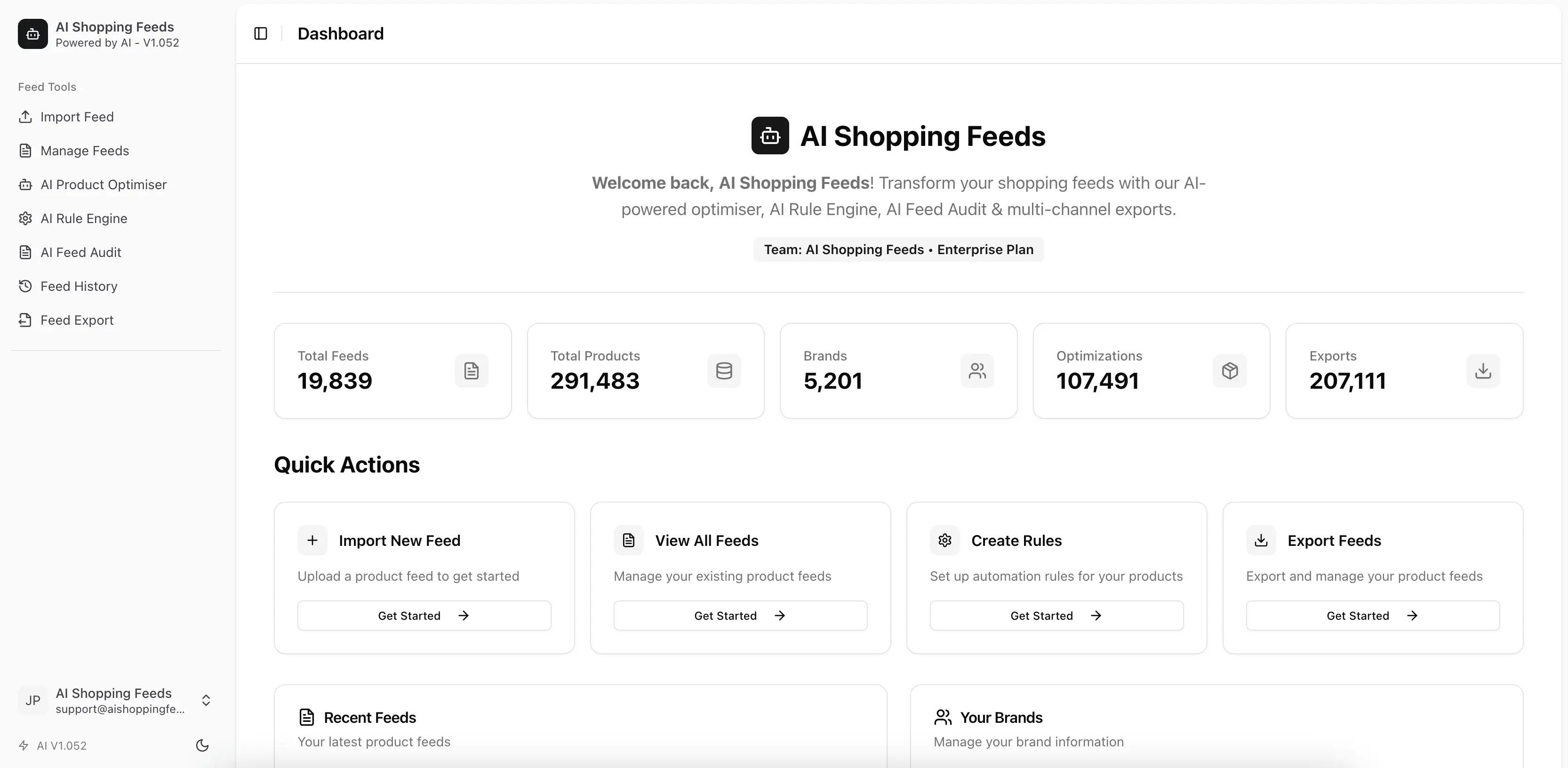
Merchant Center feed automation gets harder as the catalog gets larger, not because automation stops being useful, but because weak process design becomes more expensive. At small scale, a few manual fixes can hide a broken operating model. At large scale, the same model produces thousands of recurring problems, slower review cycles, and more painful publication failures.
That is why large-catalog automation should be treated as workflow design first and tooling second. AI Shopping Feeds is relevant here because it gives teams a governed feed-management layer for brands, feeds, products, rules, optimisation, and export-oriented handoff.
What large catalogs need that smaller catalogs can ignore
Large assortments amplify every weak process:
- missing identifiers multiply across suppliers
- inconsistent titles spread across many product groups
- manual overrides become permanent technical debt
- one bad export can affect thousands of products at once
- no one can tell which issue belongs to source data and which belongs to feed logic
This is why large-catalog automation needs more than a scheduler. It needs a control layer.
What AI Shopping Feeds does today
The current product surface supports the core pieces needed for large-catalog operations:
- brands and feeds as organizational boundaries
- product CRUD and bulk operations
- rules for repeatable transformations
- AI optimisation where it is genuinely useful
- export endpoints and public feed URL workflows
- connected operational surfaces around Merchant Center and Google Ads workflows
That matters because scale work depends on keeping product-data operations centralized and reviewable.
How it works in our app
The app lets teams structure the catalog into manageable operational units rather than treating one giant export file as the entire workflow.
Brands and feeds create useful boundaries
High-volume organizations often need separation by:
- brand
- market
- client
- workflow purpose
This segmentation keeps automation understandable and reduces blast radius when something changes.
Product operations stay in one place
Bulk updates, targeted product edits, rules, and optimisation can happen in the feed-management layer before publication.
Exports and handoffs happen from that governed state
The goal is to publish the improved feed state, not to create a second system of record downstream.
The first automation rule: automate routine work, not ambiguity
The strongest large-catalog workflows automate the tasks that are repetitive and well understood:
- field normalization
- repeatable transformations
- scheduled refreshes
- export generation
- targeted optimisation on defined subsets
They do not try to automate every exception blindly.
Segment first, automate second
One of the most common errors in large-catalog programs is trying to automate a giant mixed catalogue as if it were one uniform data shape. In practice, different segments often need different logic:
- apparel versus electronics
- branded versus marketplace supply
- domestic versus international feeds
- high-change versus low-change assortments
If those boundaries are ignored, automation becomes brittle and hard to trust.
Rules still matter in an AI-heavy workflow
Large catalogs do not need AI for every task. In fact, rules and deterministic mapping often do more of the heavy lifting:
- enforcing naming patterns
- filtering out disallowed inventory
- copying or transforming stable field values
- applying repeatable logic by segment
AI should then be used for the smaller set of tasks where semantic improvement is actually valuable, such as titles, descriptions, or category refinement on targeted product groups.
Why publication checks matter more at scale
At high volume, a weak publish cycle is expensive. Teams should verify:
- which feed is being published
- whether high-priority products are represented correctly
- whether recurring issue families have returned
- whether the export state reflects the latest intended changes
This is where controlled export and validation workflows become essential.
The operational model for large-catalog teams
The most resilient pattern usually looks like this:
Daily
- refresh the high-change product sets
- run routine QA checks
- monitor the top issue clusters
- verify export readiness
Weekly
- review recurring failures
- retire stale overrides
- refine rules and segmentation
- verify that automation boundaries still make sense
During launches
- stage the first release carefully
- validate priority SKUs first
- monitor diagnostics closely
- capture all manual interventions and turn them into system improvements
Where AI Shopping Feeds fits best
The app is most useful when it acts as the operating layer between the source catalog and Merchant Center publication:
- organize the catalogue cleanly
- run repeatable data improvement steps
- keep automation bounded
- publish from a controlled state
That is more sustainable than letting each downstream destination become its own patchwork workflow.
What not to do at scale
Do not rely on manual spreadsheet triage as the default
That may be survivable at small scale. At large scale it becomes a bottleneck.
Do not hide source problems in permanent export overrides
The larger the catalogue, the more expensive those hidden fixes become.
Do not treat AI optimisation as a universal rewrite layer
At scale, indiscriminate AI use creates review debt and makes quality harder to measure.
Do not publish from an unverified state
Large-catalog workflows need checkpoints because the blast radius is bigger.
How official Google guidance still matters
The product data specification still defines what Google expects from the downstream product data. Large-catalog automation should be designed to improve consistency against those expectations, not to invent a parallel standard.
That is why this page keeps its promise narrow: AI Shopping Feeds helps teams run the operating layer more effectively, but Google still defines the downstream rules.
Why this guidance is trustworthy
This article is grounded in the implemented AI Shopping Feeds product surfaces for feeds, products, rules, optimisation, and exports, then tied back to official Google documentation where Merchant Center requirements matter. It is written for teams that need an operating model, not just another automation slogan.
Operational checklist for large-catalog automation
Before automation scales, teams should verify:
- the catalogue is segmented in a way operators understand
- deterministic rules cover the repeatable transformations
- exception routes exist for ambiguous products
- export verification happens before publication
At large scale, these process checks matter as much as any single automation feature.
Escalation rules when scale exposes weak process
High-volume workflows usually fail in recurring ways. The organization should decide in advance:
- which issue families must go back to source systems
- which can be handled in rules
- which are appropriate for targeted AI work
- which must pause publication until reviewed
That escalation model is what keeps a large-catalog automation program from collapsing into manual firefighting.
Metrics that show automation is helping at scale
The most useful measures are:
- time to prepare a reviewed export for a large feed
- recurrence rate of the same structural issue families
- number of manual overrides still required after each cycle
- percentage of high-volume changes that pass through without emergency intervention
Those metrics tell the truth about whether scale automation is making the organization more stable.
Why this topic needs a control-layer message
Large-catalog teams do not need to hear that “AI changes everything.” They need to hear that one governed feed layer, with clear segmentation and review boundaries, is what makes automation durable. That is the value proposition the product can credibly support today.
Final take
Merchant Center feed automation for large catalogs works when the team creates segmentation, automates repeatable work, keeps exceptions reviewable, and publishes from a governed feed layer. AI Shopping Feeds supports that model by giving teams one place to manage feed operations before handoff. At scale, that discipline matters more than any single automation feature.
For the large-assortment import angle, continue to Large Assortment Merchant Centre Import Runbook. For the API architecture behind the workflow, read Ecommerce Feed API for Google Ads, Meta, and Marketplaces.
Why wait? Try it free today.
Stop managing feeds manually. Start optimising with AI in 30 seconds.
- Free plan, no credit card required
- 1 brand, 1 feed, 100,000 products per feed
- Full AI Product Optimisation, Rule Engine, and 200+ channel exports
- Pay only for AI credits when you need them